Saturday, February 19, 2011

Week Six - From Film to Franchise

        The majority of this week's lecture focused on television adaptation. As our group is looking to adapt our graphic novel to the film medium, we had to work through the lecture material and translate it's content to the film medium. What we hit on was the potential for audience participation in the creation and continuation of a franchise as well as the aftermarket potential of a franchise.
         Our screening this week was the pilot episode of Heroes, a television show that spawned a vast, interactive marketing campaign called Heroes 360 Experience. This campaign invited audience members to search through clues dropped on the show and on the series' website in order to find additional content and insight into the ongoing plots of the show. A few examples of these websites, which are at the time of this posting still available, are www.primatechpaper.com , www.activatingevolution.org , and www.votepetrelli.com .
        By including the audience in a mystery “game” that gave them extra content, Heroes achieved two things. First, the built massive hype around the show. Rather than having TV ads that give vague plot summary and attempt to build suspense in a thirty second time span, the audience were given something to delve into, explore, and invest in. An interested participant could easily spend an hour searching for hidden clues or learning the minute details of a character. Second, the audience members who found the hidden clues and websites were made to feel like they were amongst the elite. They had access to information that nobody else did. This built a strong sense of brand loyalty and helped to sustain the show through four seasons.
This type of marketing campaign is exactly what we are looking at for our own project. As described by Jeff Parker in The Temple of Atlas, a viral marketing campaign was used to market the comics by distributing codes and information through the comic book vendors that the readers could then use to find “hidden” information about the team members and the ongoing plot of the graphic novel.
         While thinking about the audience, we also started to consider the aftermarket of our franchise. In order to gain insight, we examined the aftermarket campaign of Watchmen. The first, and admittedly most obvious, area that we examined were home versions of the film. What we found is that Watchmen has had several iterations on the DVD and BluRay market. At present, Watchmen is available on DVD and BluRay in a standard, special edition, director's cut and ultimate edition. As well, there have been several related projects sold under the Watchmen franchise. These include Watchmen: The Motion Comic and Watchmen: Tales of the Black Freighter, both of which are available on DVD and BluRay. This is a very large number of products that were spawned, in essence, from one source.

These are just SOME of the Watchmen DVD collection

         We believe that our project has the potential to spawn as many, if not more, products. By using a standard to special edition to director's cut strategy, we can release more and more content over time and thus resell the original product as many times as possible. As well, by including related projects, such as the origin stories of each character or a two-for-one deal with the upcoming Avenger's movie, packaged with a third disc covering the “What if?” storyline, we can deliver content that is exclusive to a specific iteration of our film in the aftermarket.
         A second area that we explored was the video game market, a massive market amongst our key demographic. In translating a film to a video game, we discussed two possibilities. We could either mimic the story of the film, giving the audience control over something familiar, or we could build up a new storyline and give the audience a completely new experience. Using Watchmen again as an example, we can see the success of a video game adaptation. The video game Watchmen: The End is Nigh was an immediate seller, despite conflicting reviews amongst critics. As well, the video game was sold packaged with the BluRay edition of Watchmen's special edition and director's cut.

The PS3 version of Watchmen: The End is Night, with the film bundled in.

         The audience is obviously a key point in film, and all other forms of entertainment media. By including them in our adaptation process, there is much to be gained. Whether it be directly, as we've seen done in Heroes and Batman, or through the options provided to them, as we've seen with Watchmen, the audience has the final word on the success or failure of a franchise.

Parker, Jeff. Agents of Atlas. New York: Marvel, 2009. Print.

Saturday, February 12, 2011

Week Five - I've Got a Better Idea! What if...

        The focus of this week's lectures and discussion was the idea of the Generic Cycle. In particular, looking at Wandtke's article Upon a Time Once Again, we saw an emphasis on the revisionist tendencies of the superhero genre. In looking for examples of revision, we saw immediately why the emphasis is the focus of superhero storytellers. The very act of creating a superhero is a form of revision.
        For examples, we looked at our graphic novel. While one could easily point out that the return of heroes established in the mid 20th century is a revision, we looked at the specific characters and applied Wandtke's ideas to them. What we found was that three different types of revisionism exist in Agents; the revision of origin, the revision of ending, and the revision of identity.
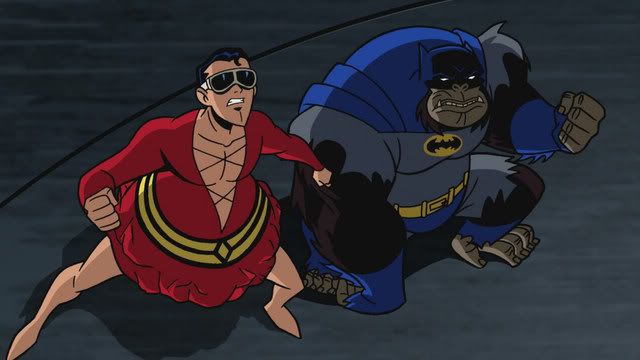
        By revision of origin, we mean that the character has been, or in our case could be, re-created without interrupting the canon. For the revision of origin, we looked at Ken Hale (Gorilla Man). In his origin story, he is cursed into becoming a gorilla by killing the previous Gorilla Man. As well, Ken states several times during the graphic novel that were someone to kill him, they too would take on his curse. This is an immensely powerful tool for revisionists as the character of Gorilla Man, be it Ken Hale or otherwise, could potentially go on forever. This trait also opens up the possibility of several different versions of Gorilla Man. Should, for example, a villainous character kill Ken Hale, the next Gorilla Man could potentially be a villain rather than a hero. This is an idea that could be played with in the further story of Agents, after the events of our film.

I know that Batman and Robin are DC, but I couldn't resist Robin in a dress. What if Batman killed Ken...

        By revision of ending, we mean that a character is brought to a point where the canon claims that they are dead and then a further storyline revives them or explains how they actually managed to avoid death. This type of revision is seen in Namora's involvement in our graphic novel. In her own canon previous to Agents, she was pronounced dead and it was intended for her to stay that way. However, Jeff Parker saw fit to bring her back from the dead by insisting that she was never really dead in the first place, but only appeared to be due to a telepathic field. To a minor extent, Jimmy Woo also fits into this category. However, we are hesitant to consider Woo a full revision as the circumstances of his “death” are presented as part of the self contained canon of the graphic novel in which is rebirth occurs.
         Finally, by revision of identity, we mean that a character is revealed to be someone completely other to who they are said to be. This type of revision is seen most strikingly in the character Venus. It is assumed through the graphic novel that she is in fact the Greco-Roman Goddess Venus. However, she is revealed by Namora to be a siren who forgot her own identity and picked up upon the myth of Venus. This type of revision is effective as a way to change the past of a hero. With Venus, we see a complete disregard for the included origin story.
       While it is fairly evident that revision is an essential part of the superhero genre, it is impossible for revision to exist without established conventions. This paradox was also a major point of discussion for our group. To this point, we came to the conclusion that revision exists as a convention of the superhero genre. This is seen in the film Kick-ass and the graphic novel Watchmen. In both cases, it is the presence of the conventions of the superhero genre within the diegesis that lead normal people to become superheroes. While Hollis Mason gets his inspiration to become the first Night Owl from the pulp comics of his day, Dave Lizewski gets his inspiration to become Kickass from graphic novels like Watchmen. This constant cycle of inspiration is an example of using the established conventions of previous superhero stories in a revisionist way.

       
Dave gathers inspiration at the comic book store.

Kick-ass. Dir. Matthew Vaughn. Perf. Aaron Johnson, Chloe Moretz and Nicolas Cage. Marv Films, 2010.

Moore, Alan, and Dave Gibbons. Watchmen. New York: DC Comics, 1987. Print.

Parker, Jeff. Agents of Atlas. New York: Marvel, 2009. Print.
Wandtke. "Once Upon a Time Once Again." Wandtke. Once Upon a Time Once Again.pdf. Web. 12 Feb. 2011.

Saturday, February 5, 2011

Week Four - The Problem of Being a Superhero

        In this week's reading, The Definition of a Superhero by Peter Coogan, we were faced with a list of characteristics describing a superhero. Coogan argues that the central markers of the superhero are “mission, powers, identity and generic distinction” (Coogan 90). When we then applied this paradigm to the characters in Agents of Atlas, we found that perhaps Coogan's definition may need further refinement. In particular, we compared Coogan's paradigm to the character of Jimmy Woo, though we did examine the remainder of the team as well. We then examined alternative definitions of a superhero and concluded that the Agents are simply a different breed of hero to those Coogan describes. Without further ado, let us examine and criticize Coogan's paradigm.

A generic superhero.

        The first marker that Coogan gives is the mission of the superhero. While each member of the Agents has their own reason for joining up with Jimmy Woo, the mission itself is to find and bring down the Atlas Foundation. Coogan says that “the superhero's mission is pro-social and selfless” (77), which would seem to be a common thread for certain amongst the superhero genre. As a matter of fact, we can see the application of this principle in the Agents original mission. Storming a heavily guarded fortress in order to save the President of the United States is, indeed, pro-social and selfless. In pursuing the Atlas Foundation, however, we see a side to Jimmy Woo that is consumed with the need for revenge and a thirst to prove himself. In this sense, Woo's mission is not so much about stopping crime, but rather catching the criminal. We see this attitude reflected in Dick Tracy. While Tracy is indeed attempting to rid the city of crime, he is doing so by relentlessly pursuing one man: Big Boy Caprice. Tracy's mission, therefore, is not in fact to uphold pro-social and selfless ideals, but rather to selfishly pursue one man, his nemesis. While both Caprice and “Yellow Claw” are criminals in their respective plots, the hero characters associated with them see them as nemesis first and foremost. The idea of defeating one's nemesis becomes the mission of both Jimmy Woo and Dick Tracy.

Jimmy's need to capture "Yellow Claw" exceeds even his love for Suwan.

        Coogan's second marker is the presence of powers. He cites Judge Leaned Hand in suggesting that superpowers are “extraordinary abilities, advanced technology, or highly developed physical, mental, or mystical skills” (Coogan 77). Once again, we can look at the Agents to find these characteristics. Venus certainly does have extraordinary abilities, the ability to control men through song for one. Marvel Boy has access to highly advanced technology, his spaceship among other things. And characters like Jimmy, M-11 and Namora seem to exemplify the highly developed physical, mental and mystical skills suggested. So far, this marker seems to be holding up. However, we are missing one key character in our comparison. Ken “Gorilla Man” Hale, is, quite simply, unexceptional. Aside from having the mystical imposed upon him, he is no smarter than the average human nor any stronger than the average gorilla. He is an example of the everyman in gorilla form. This again relates back to Dick Tracy. The titular character, like Ken, has no exceptional abilities. He is the everyman in a world that begs for the exceptional. What Jeff Parker may have been doing in writing Agents of Atlas is in fact suggesting this very thing. While Ken Hale is not a superhero in terms of powers, the group collectively contains all types of powers, and thus his association gives him powers. Likewise, Tracy is considered powerful only by his need to stop the city's crime. Both Ken and Tracy are called to action, rather than given the responsibility.

Ken is just like one of us!

        Coogan's third marker, and the final one we will be discussing, is identity. Coogan suggests that “the identity element comprises the codename and costume, with the secret identity being a customary counterpart to the codename” (78). Here again the Agents seem to fall out of the category of superhero. Several of our team have code-names, but prefer to be called by their proper names. Ken Hale is known as Gorilla Man, but is rarely called that name. The same pattern is seen in “Marvel Boy” Bob Grayson. Then there are characters who simply have no codename. Jimmy Woo, M-11, Namora and Venus all go by their “real” names. I use real in parentheses simply to cover the fact that M-11 and Venus have back stories that concern the truth behind their identities, which is an entirely different matter. Once again we can look to Dick Tracy and see the same pattern. The closest thing that we have in Dick Tracy to a hidden identity is “The Man With No Face,” and even that character is not a superhero.
        By way of a conclusion, we can say that the idea of a superhero is still a concept that is being shaped and molded into different forms. We are willing to assert whole heartedly that each member of the Agents is in fact a superhero, though the generic markers suggested by Coogan may say otherwise. While mission, powers and identity so play a key role in most superhero narratives, it is folly to suggest that they are central to the entire genre.

Coogan, Peter. "The Definition of a Superhero." Coogan. Definition of a Supehero.pdf. Web. 02 Feb. 2011.

Dick Tracy. Dir. Warren Beatty. Perf. Warren Beatty, Madonna, Al Pacino. Touchstone Pictures, 1990.

Parker, Jeff. Agents of Atlas. New York: Marvel, 2009. Print.

Saturday, January 29, 2011

Week Three - The Universality of Archetypes

        The main focus of our class this week was the idea of superhero archetypes. These archetypes, as they relate to adapting a graphic novel like Agents of Atlas, seem to lend themselves readily to further investigation. Of particular interest to our group were the Antediluvian Age archetypes: the Science-Fiction Superman, the Dual Identity Avenger-vigilante, and the Pulp Ubermensch.
        The first of these archetypes can be seen in two of our heroes. The first is through the Uranian Marvel Boy, Bob Grayson. He is from a highly advanced society where powers can be given through scientific exploration. In this way he reflects the basic associations of the archetype. In order to see the full application of the archetype, however, one need only look to M-11. In many ways, M-11 is the re-telling of our example for the Science-Fiction Superman: Frankenstein. He is created in a lab as something bigger than humanity, achieves consciousness and then kills his creator, taking a part of him into himself and receiving not just life, but humanity. M-11 seems to be built specifically to fit this archetype.
         As an interesting contrast, we can see Batman and The Joker, as portrayed in Tim Burton's Batman (1989), in a similar light. He is created by an act of violence when Jack Napier kills his parents. As a reflection, Jack Napier is transformed into the Joker by Batman. Batman and The Joker don't have any truly superhuman powers, but rather are aided by technology and science.
         The second archetype, the Dual Identity Avenger-vigilante, can be seen in the Agents' Venus. While the beginningg of the narrative builds Venus as the actualGoddessss of Greco-Roman myth, it comes to light that she is in fact a monster who comes to believe that she is thGoddessss Venus. In this way Venus reflects the dual nature of many superheroes. One side is essentially evil and dark while her heroic side is the exact opposite.
         Batman can, again, be applied to this second stereotype. In the film, Batman is a vigilante who goes above and beyond the law to administer what he believes to be justice. This sense of justice becomes corrupted when faced with Jack Napier, the murderer of his parents, and Batman destroys a chemical plant, effectively killing everything inside. By contrast, his true identity, Bruce Wayne, is constantly seen at charitable events and gives his wealth freely to those who attend, as expressed in the decision to open two more crates of champagne. The effect of this is once again a divide between the character's true identity and their “heroic” side, though in the case of Batman and Venus the method seems reversed.
         The final archetype we investigated is the Pulp Ubermensch. Our example of this archetype was Tarzan of the Apes. Of course, the first example that should come to anyone's mind is Ken Hale, the human gorilla. The effect is, again, the same as the example. A man who was raised by gorillas as a gorilla is just the reverse story of a human raised by humans becoming a gorilla. Ken is the character who does not fit in to his own society and is left behind for it.

Ken and M-11 fight their way out of S.H.I.E.L.D.
Similarities between Ken and Batman go deeper than their status as outcasts.

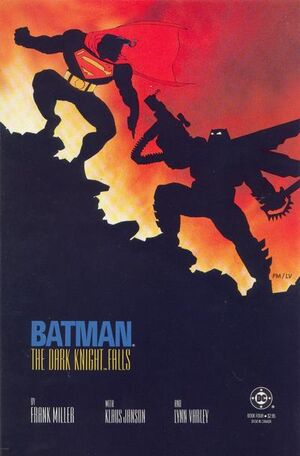
         In order to apply this archetype to Batman, we must look to Frank Millers The Dark Knight Returns. In the beginning of the narrative, Batman is retired and, by all rights, should be happy. However, while his society is content to stand by and allow crime to take their streets, Bruce Wayne must fight back. In this way, he too is different from his own society. The only other similarity, which is common between both the graphic novel and the film, is Batman's association with bats. It seems as though he prefers the company of the “great survivors” to those who allow themselves to be overrun and harmed.
        While it is all well and good to identify archetypes in common between our work and the works in class, it is also important to analyze what these similarities mean for our adaptation. For this we looked again to McCloud's second chapter in Understanding Comics. McCloud makes a point of discussing the level to which we identify with a character compared to the level of “realism” present in their depiction. Our group found an interesting parallel between this idea and the idea of archetypes. We suggested that perhaps the level of realism was less important than the archetypes, particularly when analyzing film. By way of example, a cartoon version of Superman, like the one we saw in week two, is infinitely less relateable than a version who is much more (an you'll excuse the pun) drawn out over time, like the depiction we saw in Superman: The Movie. When we understand Superman as an archetype, we can automatically associate certain problems with him and ourselves, and thus feel a stronger connection to his struggles.

Batman. Dir. Tim Burton. By Prince. Perf. Michael Keaton, Jack Nicholson, Kim Basinger, Billy Dee Williams, and Jack Palance. Warner Bros., 1989.

McCloud, Scott. Understanding Comics: the Invisible Art. New York: HarperPerennial, 1994. Print.

Miller, Frank. Batman: the Dark Knight Returns. New York, NY: DC Comics, 2002. Print.

Parker, Jeff. Agents of Atlas. New York: Marvel, 2009. Print.

Saturday, January 22, 2011

Week Two - Questions of Adaptation.


Adapting a narrative from one form of media to another is always going to be a jarring process. Whether one pays strict attention to staying “true” to the original text or simply tries to capture its tone and greater themes while adding and omitting other sections can greatly affect the adaptation’s reception. Obviously different audiences would be looking for varied aspects going into a film reworking a comic book. Indeed, as we learned in class this week, the differing levels of connection to the primary text – i.e. the audience’s prior knowledge of the narrative – going into the film is of paramount importance and can drastically shift the way the film is received. However, these are not the only considerations one must make when adapting a comic to film.

Pascal Lefèrvre, in his article ‘Incompatible Visual Ontologies: the Problematic Adaptation of Drawn Images’, highlights the similarities that make comics such good candidates for film adaptation while also asserting the differing characteristics between the two mediums that can obstruct the process.  

“Films and comics are both media which tell stories by a series of images: the spectator sees people act – while in  a novel the actions must be verbally told. Showing is already narrating in cinema and comics, but while classical cinematic narratives situate the spectator at the centre of the diegetic space, comics on the other hand are rooted in a parodic tradition”                                                                                    (Lefèrvre: 3)
Given that both mediums are intrinsically visual, the notion of adaptation seems logical. However, as Lefèrvre argues, there are rather large problems with this theory. Unlike comics, the cinematic experience places the audience within the film via the use of sensory-deprivation and various other techniques. This gives the viewer the feeling that the film is real: they are engrossed and absorbed by the filmic devices as all other “distractions” are removed. While comic books, by their nature as a silent, printed medium, keep the audience away from such a state. Comics allow for such distractions to come through and displace the reader from the text. Essentially while movies attempt to bring the audience wholly into the narrative, comics keep you out.

Moreover, as we have learned this week in Scott McCloud’s discussion on the existence of “gutters” between the panels of comic books, the very nature of time and space is treated much differently in either medium. The notion of differing compositions between cinema and comics plays an integral role in discerning narrative aspects such as pacing which, while being one of the more subtle filmic techniques, proves to be crucial within both art forms. McCloud’s emphasis on varying panel compositions and their ability to either quicken or hinder the pace by which the reader “reads” each image is of paramount importance when considering adaptation of specific comic “scenes” to film. For example, within Zack Snyder’s adaptation of Moore and Gibbons’ “Watchmen”, the audience is privy an extremely faithful reworking of the famed graphic novel. However, within Nite Owl’s dream sequence (in which Dan and Laurie appear to be on mars and are enveloped by a nuclear explosion) as originally illustrated by Gibbons, the singular page structure is composed of a series of 16 smaller panels which gives the reader a feeling of quick succession, of rapid movement. Due to the fact that there is minimal information to decipher within the images, the reader quickly glosses over them. Snyder’s rendition of the scene is much more fluid and essentially dream-like in its representation, only using under 10 cuts to deliver the scene. The two scenes – while looking remarkably similar – each give a different tone to the sequence.

This ultimately highlights the difficulties evident in adapting a “still” medium to one steeped in movement.

 Works Cited.
  • Lefèvre, P. (2007). Incompatible Visual Ontologies? The Problematic Adaptation of Drawn Images. In Ian Gordon, Mark Jacovich, Matthew P. McCallister, Film and Comic Books (pp. 1 - 12). Jackson: University of Mississippi.
  • McCloud, Scott (1993); Understanding Comics: The Invisible Art; New York: Harper Collins Publishers Inc.
  • Moore, A & Gibbons, D (1987); Watchmen; New York: DC comics.

Saturday, January 15, 2011

Week One - The Creative Process Begins

        Icons, as defined by our first reading in Understanding Comics, are symbols that hold meaning. This concept is very important to our class as we are essentially tasked with transferring the meaning of symbols and images on the page to the film medium. In our group discussion, we talked at length about the different ways in which the idea of an icon can influence the creative process of adapting a graphic novel to film.

        While examining our own project, we first decided to take into consideration the implications of McCloud's description of icons upon the process of adaptation. The characters of Agents of Atlas, after all, do seem to lend themselves very readily to the very topic. Each character in the group seems to represent a from of iconic archetype. This representation is seen most clearly in one of the novels tag-lines: “The spy. The spaceman. The goddess. The robot. The gorilla.” Each character seems to bring to the team a unique quality that is defined entirely by their physical representation on the page. The archetypal quality of these characters is again reflected in the “What If” scenario included in the back of the graphic novel. In a series of panels, each member of the Agents of Atlas is compared to a member of the Avengers. As McCloud suggests, the reader then takes these archetypal icons and sees, within their characteristics, a new form of self. In the case of characters like Gorilla Man or the Avengers' Beast, a reader may see their animalistic side, while in M-11 and Vision a reader may see their calm, logical side. The proper application of these iconic archetypes is essential to our moving forward in adapting Agents of Atlas.

        In moving forward, however, it is perhaps beneficial as well to move back. A second key area of interest when discussing icons in our group was the distinction between the icons of the early origin comics, ranging from 1947 to 1978, and the newer story of Agents of Atlas published between 2006 and 2007. While the origin stories feature very unrealistic graphics (as defined by McCloud's pyramid on page 51 of Understanding Comics), the more contemporary icons seem to have shifted toward the realistic. In considering aspects of our adaptation like the level of realism, particularly as it relates to the characters of Gorilla Man and M-11 (being difficult to outfit without CGI), this shift plays a major role.

         For how the role of realism in comics has altered existing superhero film franchises, we needn't look any farther than the several examples of Superman that were shown in class. Several of the early clips that we saw were not extremely particular about maintaining realism, presumably because the comics of the time were less interested in portraying realism. As an example, the clip in which Superman flies up in to a burning building uses animation in order to show flight. By contrast, the most recent clip from Smallville attempts to show every gritty detail of the meteor shower, even taking a slow-motion moment to focus on a young crying Lana Lang.

        The distinction between icons of the 50's and contemporary icons is one that our group is going to have to consider very deeply, as our story takes place not only in the present but largely in the past. As well, the archetypal nature of our characters will need to be considered in casting and staging them. After all, film and comics are both constructed out of an endless swarm of icons.